

How The Statement Analysis Con Starts
When shopping for a new merchant account, you are likely to encounter a salesperson from a competing credit card processing company who wants to offer you a “free statement analysis.” On the surface, the offer sounds great. They are telling you that they can save you money on processing costs and show you how much you will save in comparison to your current credit card processor. What a great deal! Or is it?
Agreeing to a free statement analysis from a credit card processing company is risky for a few reasons:
- Wolf in Sheep’s Clothing: Often, it’s the worst processors that utilize the “free statement analysis” tactic to lure unsuspecting business owners into a high pressure sales gambit. In this common scenario, you unwittingly hand over your statement to shady salesperson who then returns a report showing his company’s costs compared to your current processor. It will show you substantial savings. All that you have to do is switch your processing to his company and the savings will start flowing in. But, as you might have suspected, there’s a catch.
His “manager” says that the rates go up tomorrow so you need sign up today or the offer is off of the table. You don’t want to lose such a great deal, so you sign the application without reading the fine print. A few months go by and the fees are actually more expensive than what you were previously paying, plus the customer support is awful, and your sales rep is nowhere to be found. Never to be heard from again.
You try to cancel but that’s when you find out you signed a contract that is going to cost you thousands to terminate. Now you’re stuck with them for years and they keep jacking up your fees the whole time. It’s a nightmare that countless business owners have experienced. The lesson is clear: never share your statement with a competing salesperson who is trying to get your business. - Smoke and Mirrors: A shady processor’s goal is to show you a carefully manufactured side-by-side report demonstrating savings over your current processor’s costs. These reports are rarely an accurate representation of your actual processing costs, nor are they a true prediction of the costs you can expect by switching services. In most cases, the cost comparison you receive is a rough, ballpark estimate at best. Or, at worst, was a complete lie the whole time.
- Tipping Your Hand: When you send your statement to a processor, you may be unintentionally revealing sensitive information about your business that can be leveraged against you during pricing negotiations. Keep your processing data close to your chest. You don’t want them to know if you are holding already holding a straight flush.
- Trojan Horse: When a prospective processor sees how your current processor is assessing your fees, you give them everything they need to manipulate the data in their favor. Do you know the difference between Interchange-plus, blended, tiered, or any of the other half dozen rate shemes? Would you be able to tell if they are comparing apples-to-apples across your fees?
They will be paying close attention to your level of knowledge as you discuss their cost comparison to see if you actually understand what you are looking at. Experts can always spot an imposter, so don’t risk looking like one by handing your statement over to them.
Credit card processing companies thrive on the complexity of rates and fees. They have no incentive to help you truly understand how much you could actually be saving.
How to Get a True Picture of Your Processing Costs
If you want an honest analysis of your processing costs and where you can save, the best approach is to obtain an independent “Statement Audit” from a consultant who is not trying to sell you credit card processing services.
A statement audit is different from “statement analysis” because it is not comparing your current fees with another credit card processor’s fees.
A statement audit reveals what you are paying in comparison to the actual wholesale rates assessed by the credit card processing networks without any markups or junk fees. It then breaks out every unnecessary fee and markup being charged by your current processor to identify how much profit they are making from your credit card processing.
How a Statement Audit Works
A Statement Audit reveals everything about the underlying card network costs as well as the fees added by your processing company.
Step 1: Identify Non-Negotiable Costs
An audit starts by identifying the fees paid to the banks that issued your customers’ credit cards, known as “Interchange.” Next, it segments the fees charged by the card brand networks (VISA, MasterCard, etc) called “Dues and Assessments”. These fees are the wholesale cost of the credit card processing ecosystem and are only negotiable with the networks themselves, if you process a high enough volume. Most business don’t, so these costs are unavoidable for the majority of businesses. Segmenting the network costs reveals markups by your processor that may by hidden via clever, and often illegal, rate padding.
Example of Illegal Rate Padding
In the audit example below, the processor was charging a business a rate of 0.53% on debit card transactions, which are regulated under the Durbin Amendment to be no higher than 0.05%. This means the processor was hiding an illegal 0.48% hidden markup that was costing this unsuspecting business owner nearly 10X more than it should have been paying. Hidden rate padding is virtually impossible for the average business owner to detect because it requires cross-referencing the nearly incomprehensible rate disclosures published by the card networks.

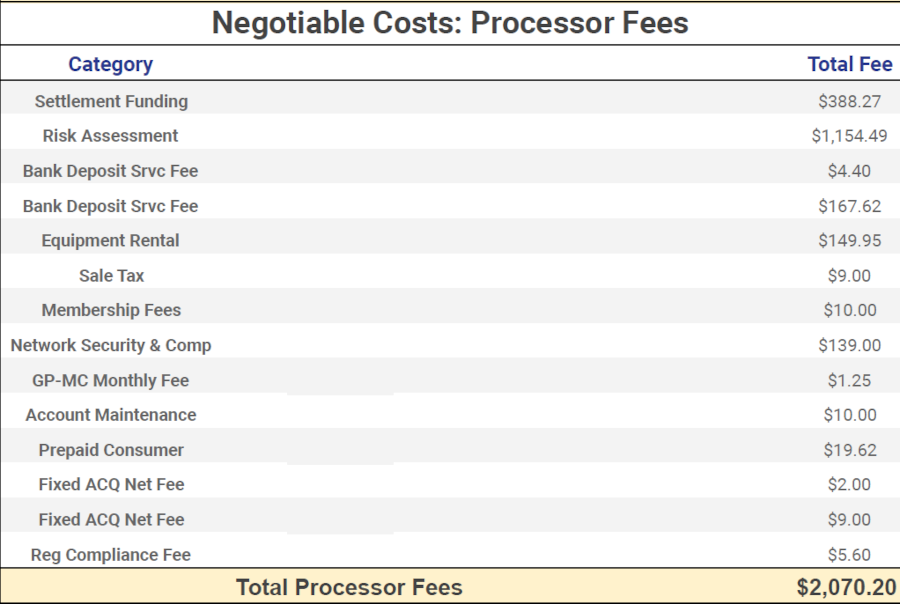
2. Extract Processor Markups and Fees
Next, an audit will identify all of the margins and markups that a processor adds on top of the wholesale rates, along with listing all junk fees that can be negotiated or removed altogether, such as unnecessary monthly and annual fees.
3. Compare Your Costs to Potential Savings
Lastly, an audit summarizes your current processing costs compared to what you could expect with an ethical, low-cost processor, or through renegotiation with your current processor if they are willing to come to the table.
What’s The Catch?
It seems like there is always a catch or trap in the credit card processing industry. If you are suspicious, you have every right to be. In most cases, you would be correct in believing that something like a statement audit is disguising an ulterior motive. This is why a true statement audit from a legitimate consultant is never free.
Statement Audit Cost
You should expect to pay a few hundred dollars per statement, and it’s wise to have more than one statement audited as not all fees occur on every statement. So, is paying hundreds of dollars for a Statement Audit a smart business decision?
A “Statment Audit” is not the same as a “Free Statement Analysis”
Value of a Statement Audit
Every one of the hundreds of statements we have audited contained removable rates and fees. In fact, we have found that the average business is paying 47% more in processing costs than necessary. Over the last decade, we have uncovered millions of dollars in junk fees that businesses were blindly paying, completely unaware of how much they were losing in avoidable costs.
Our findings have shown that businesses processing between $400,000 and $5,000,000 in annual credit card transactions are most at risk of grossly overpaying for credit card processing services, with many incurring excessive fees totaling tens of thousands of dollars annually. Businesses processing under $400,000 are still at risk of overpaying. A professional consultant will let you know if a full audit will be worth the expense of an audit.
What About Using AI to Audit a Statement?
Services like ChatGPT and Claude can be useful for flagging specific fees, but they currently miss things like hidden rate padding and other nuances that an auditor has experience looking for. However, AI tools are great for analyzing service agreements and noticing provisions that could come back to haunt you.
Beware of “Free Merchant Cost Consultations”
Companies that are not marketing credit card processing services to you, but offer to audit your statement at no cost, are never just charitable saints trying to save you money.
First, the primary goal of anyone willing to fully analyze your statement for free is to convince you to allow them to renegotiate your fees on your behalf. If you agree to let them negotiate for you, most of them require that you fork over half of the savings for a period of years.
The cost their cut will likely run into the thousands as they bill you for their portion of the savings. When you factor what they take, you may only achieve realized savings of 10% to 20% as compared to your original costs. That’s a savings you could achieve on your own with just basic know-how. It’s better to pay upfront and avoid long-term obligations.
“Free” is rarely free in the merchant account industry.
A Free Report is “Free,” Right?
What if you don’t agree to let them negotiate on your behalf? At least you get a free statement analysis, right?
First, the analyses these companies provide are intentionally vague. They don’t want to give you all of the details on where you are getting overcharged because you could just take such information and do the negotiation yourself. They want you to believe that you need them. They want you to believe it’s all just too complex and that you won’t be able to achieve substantial savings on your own.
Many will use high pressure sales tactics and continually market their consultation services to you until the end of time. Some are even known to sell your statement to shady merchant account resellers who will endlessly call you and show up to your place of business trying to get you to switch to their processing services. Avoid headaches and unnecessary savings-split commitments by paying upfront for a true Statement Audit from a reputable consultant.
It’s More Important Than Ever
Why is it imperative that you audit your today? Because it’s likely that you are being overcharged without your knowledge or consent, and it could get worse. A recent Supreme Court decision may remove much of the government’s ability to regulate the payments industry. This could lead to an avalanche of new fees quietly being added to your processing costs. It’s important to eliminate excess fees now to ensure that any attempts to add new fees later will be blatantly apparent.
What a Statement Audit Will Show You
A comprehensive statement audit will reveal hidden charges, inflated rates, billing mistakes, and other discrepancies that are costing your business more than necessary. By identifying these issues early, you can negotiate better terms, switch to more cost-effective service providers, and streamline your payment acceptance processes.
As a best-practice, it’s a good idea to have your statements audited on an annual basis to ensure that your processor is in compliance with developing industry standards, network rate and fee changes, and honoring their agreed upon pricing. Protecting your business from inflating processing costs is a critical part of maintaining your profit margins.
Join The Waitlist
Due to high demand we are currently only accepting waitlist statement audit clients. If you are interested in having your statement audited, please fill in the form below.
Our response will include the following:
- An initial statement review to ensure that a full audit will be worth the expense.
- A firm quote to fully analyze your statements for a full break out of all unnecessary fees and rate markups.
- A reliable estimate of the cost savings potential you could achieve through tactical negotiation with your current processor.
- A list of alternative low-cost processors that serve your industry well.
- Upon initiating our audit services, we will also provide to you, “Fee Sweep,” our comprehensive ebook that provides a step-by-step guide for negotiating the lowest credit card processing fees on your own.