
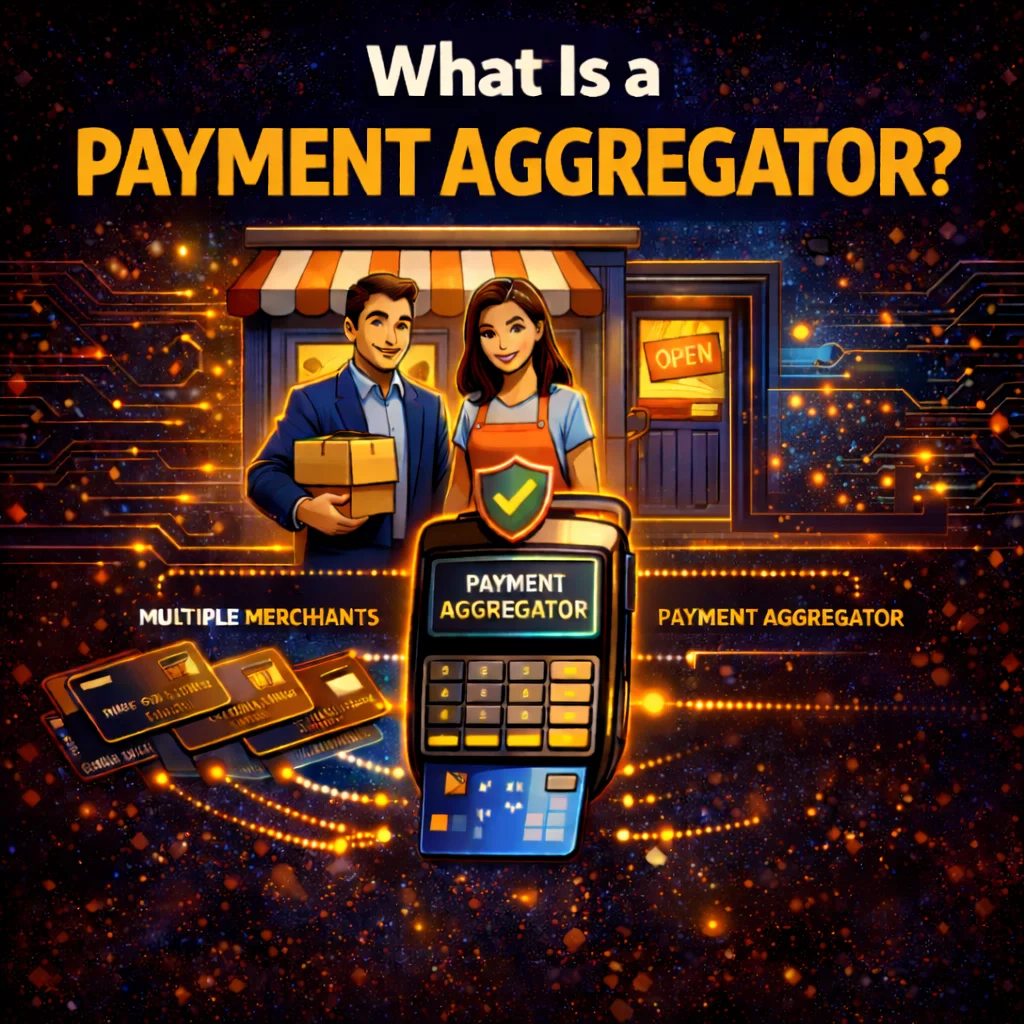
A payment aggregator is a payment services company that lets many small merchants accept card payments under a single, shared merchant account rather than each merchant obtaining an individual account with an acquiring bank. Square, Stripe, PayPal, and similar providers are the best-known examples. For the business owner, signing up takes minutes and there is almost no underwriting up front. For the aggregator, the trade-off is assuming all the risk that a traditional acquirer would normally push onto the merchant. Understanding that trade-off is the key to deciding whether an aggregator is the right fit for your business.
How a Payment Aggregator Works
In the traditional card-acceptance model, a business applies for a merchant account an acquiring bank or an independent sales organization, goes through underwriting, and receives a dedicated Merchant Identification Number (MID). Every transaction the business processes is tied to that MID, and the acquirer assumes direct responsibility for the merchant’s risk profile with Visa, Mastercard, American Express, and Discover.
Aggregators flip the model. The aggregator itself holds the relationship with the acquiring bank and the card brands, and all of its sub-merchants process under the aggregator’s master MID. From the card networks’ perspective, a provider like Square, is the merchant. The coffee shop accepting cards through a Square reader is a sub-merchant sitting underneath Square’s umbrella. That structure is what makes instant onboarding possible: the aggregator has already done the underwriting with the bank, and signing up a new seller is really just adding a sub-account to an existing relationship.
For a more detailed comparison of aggregators, gateways, and dedicated merchant accounts, see our guide to merchant accounts versus gateways and platforms.
Examples of Payment Aggregators
The aggregator model is dominated by a handful of large providers, each with a slightly different focus.
- Square is built around brick-and-mortar and mobile retail, with tightly integrated hardware, point-of-sale software, payroll, and business banking. Our Square Register review covers the retail product in depth.
- Stripe is developer-focused, with an extensive API and a product catalog aimed at online commerce, SaaS billing, and marketplaces. See our Stripe review for pricing, features, and complaints.
- PayPal has the largest consumer-wallet footprint and is commonly used as a checkout option alongside card acceptance. Our PayPal review walks through the full merchant experience.
- Braintree, a PayPal-owned platform, blends aggregator-style onboarding with some dedicated-account capabilities. See our Braintree review.
- Shopify Payments, Wix Payments, and Squarespace Payments are aggregator implementations bundled inside e-commerce platforms, typically powered by Stripe under the hood.
Traditional acquirers such as Fiserv also offer aggregator-style products for their resellers, but they primarily issue dedicated merchant accounts.
Advantages of Using a Payment Aggregator
The aggregator model became dominant in small business processing for good reason. For the right type of merchant, the benefits are substantial.
Fast, low-friction onboarding. A new seller can typically create an account, enter basic identity and bank information, and begin processing the same day. There is no formal underwriting interview, no paper application, and usually no contract with a minimum term.
Flat, predictable pricing. Most aggregators publish a single flat rate per transaction, such as 2.9 percent plus $0.30 for online card-not-present transactions. Interchange, assessment, and processor margin are all bundled into that single number. Flat pricing is usually more expensive than a well-negotiated interchange-plus plan for higher-volume businesses, but it is far simpler for small merchants to budget against.
No monthly minimums or PCI fees. Because sub-merchants share a master MID, aggregators typically do not charge monthly minimums, statement fees, annual PCI compliance fees, or early termination fees. Merchants pay when they process and pay nothing when they do not.
Integrated software and hardware. The major aggregators ship card readers, point-of-sale apps, online store builders, invoicing, subscription billing, and virtual terminals as part of a single platform. A small merchant can run a full business on one account.
Low volume friendly. A merchant that processes only a few hundred dollars per month is a money-loser for a traditional acquirer, which is why most acquirers impose monthly minimums. Aggregators are engineered around that long tail of small sellers and welcome them.
Disadvantages and Risks
The trade-offs of the aggregator model are almost all risk-related, and they become more pronounced as a business grows.
Automated risk decisions and sudden account freezes. Because aggregators skip front-end underwriting, they rely heavily on back-end fraud scoring. A holiday sales spike, an unusually large invoice, or a cluster of disputes can trigger an automated fund hold or account termination with very little human review. This is the single most common complaint about Square, Stripe, and PayPal, and we cover it in depth in our guide on making your payment processor release your money.
Long reserve windows. Aggregator contracts typically reserve the right to hold funds for up to 180 days following a risk event. Holds rarely last that long in practice, but the ceiling exists, and cash flow can be disrupted for weeks.
Higher cost at scale. Flat pricing is convenient, but on volumes above roughly $10,000 to $25,000 per month, a well-negotiated dedicated account on interchange-plus pricing usually saves real money. Merchants who outgrow their aggregator often find themselves paying hundreds of dollars per month more than necessary.
Narrow category tolerance. Aggregators publish long lists of prohibited and restricted businesses. Nutraceuticals, CBD, firearms, adult content, debt collection, dating, travel clubs, and many subscription and high-ticket models are either forbidden or tightly restricted. A merchant who signs up without checking the prohibited list can be terminated later, often with little warning.
Limited chargeback support. Dispute processes inside aggregator platforms are often self-service, with evidence uploaded through a web form and decisions handed down with minimal interaction. Merchants who want hands-on chargeback management should read our guide to fighting chargebacks and winning before relying on an aggregator for a dispute-heavy category.
Less negotiation leverage. Dedicated merchant accounts are negotiable on rate, reserve, and contract length. Aggregator pricing is take-it-or-leave-it for most sellers, with custom pricing usually reserved for very large accounts.
When an Aggregator Is the Right Fit
Aggregators are a strong fit for many new, small, or low-volume businesses. Consider one if your business checks most of these boxes: monthly processing volume under about $10,000, a standard-risk product or service, predictable transaction size, limited technical resources to manage a gateway and separate merchant account, and a need for integrated software tools such as invoicing, scheduling, or an online store builder.
In these cases, the simplicity and speed of an aggregator usually outweigh the marginal cost savings of a dedicated account.
When You Should Consider a Dedicated Merchant Account Instead
Graduating to a dedicated merchant account makes sense when your business develops any of the following characteristics: monthly processing consistently above $10,000 to $25,000, a high average ticket, seasonal volume spikes that trigger aggregator holds, a chargeback ratio above 0.5 percent, or a product category the aggregator has flagged as restricted.
A dedicated account offers interchange-plus pricing, a direct underwriting relationship that reduces the chance of a surprise freeze, negotiated reserves, and a dedicated risk analyst rather than an automated scoring system. The onboarding is slower and the paperwork heavier, but for the right business the savings and stability are worth it.
How to Protect Yourself on an Aggregator Platform
If you choose to use an aggregator, a handful of operational habits will dramatically reduce the chance of a disruptive account event.
Read the prohibited-business list before signing up and again before launching a new product. Many account terminations trace back to a product the merchant did not realize was restricted. Notify the aggregator in advance of large transactions or seasonal surges so the risk team is not surprised by the pattern. Keep chargebacks below 0.5 percent by using clear billing descriptors, responsive customer service, and pre-dispute alert programs such as Ethoca and Verifi. Maintain a secondary processor, even a dormant one, so that a freeze on your primary account does not stop the business. And keep impeccable records of every transaction, because aggregator disputes are won on documentation, not phone calls.
The Bottom Line
A payment aggregator is a shortcut through the normal merchant-account underwriting process, paid for in the form of automated risk decisions, flat pricing, and narrower category tolerance. For the small, standard-risk businesses that make up the majority of Square, Stripe, and PayPal users, the shortcut is a fair bargain and often the fastest path to accepting cards. For higher-volume, higher-risk, or more complex operations, a dedicated merchant account is usually worth the extra effort. Knowing which camp your business belongs in, and planning the transition before it becomes urgent, is one of the most valuable decisions a new merchant can make.