We take our role in providing guidance and education regarding the card payment industry very seriously. At our own expense, we have vigorously defended our right to continue expose unethical and predatory practices in the industry, successfully defeating every attempt to silence us. However, fending off frivolous lawsuits is costly. To sustain these efforts, one of the ways we generate revenue is through affiliate partnerships with ethical providers. This means that some of our outgoing links connect business owners to trustworthy, low-cost payment processors, which is what most of our readers seek. We see this revenue channel as a win-win-win for everyone involved. Business owners find good processors, processors get good clients, and we are able to continue to provide a valuable service to the small business community. We also recommend and link to many services that do not compensate us. Our priority is to guide you to the best solutions for your needs, regardless of potential revenue. If you have questions, please feel free to contact us.
All mentions of rate and fee costs are estimations based on publicly available information and client feedback. Actual costs may vary based on a variety of factors unique to your business.
In this review of Apple Pay, we’ll provide an overview of Apple’s mobile wallet and payment service. We’ll cover the features it offers, including contactless payments, online transactions, and seamless integration with Apple devices. We’ll also highlight which users and businesses may benefit most from these features. In addition, we’ll examine user feedback to point out common trends, praise, and concerns. We’ll review Apple Pay’s security measures, its compatibility with banks and financial institutions, and its unique features. By the end, you’ll have a clear idea of whether Apple Pay is the right choice for your mobile payment needs.
About Apple Pay
Apple Pay Homepage
Apple Pay is a mobile wallet application for all iPhone models after the iPhone 6 and for the Apple Watch. It utilizes the iPhone’s NFC capability in conjunction with a built-in fingerprint scanner to enable customers to pay for products with their phones at physical retail locations and within various iPhone and iPad apps. In September 2018, Apple also added the ability to send money to other Apple Pay users in the Messages app (known as “Apple Pay Cash”), similar to Venmo or Square Cash.
Before they can use the service, Apple Pay users are first required to enter their card information into each device’s Wallet application, where the card information is tokenized and stored. They can then use Apple Pay to make purchases at all NFC-enabled credit card terminals with just a tap of their phones. Apple Pay’s primary competitors are Samsung Pay and Google Pay. Tim Cook is the CEO of Apple, whose headquarters are located at 1 Infinite Loop, Cupertino, California.
Products & Merchant Services
Apple Card
On August 20, 2019 Apple launched the Apple Card. The card integrates into Apple Pay users’ digital wallets. The card also provides users with similar benefits to conventional credit cards. Those benefits include 3% cashback for purchases from Apple, and 2% for any purchase made using Apple Pay.
Customer Reviews & Sentiment
Largely Positive Feedback
Apple Pay is widely praised for its ease of use, robust security features, and convenience. Both users and experts find it a useful payment method, performing as expected. However, a limited number of participating locations is frequently mentioned as a drawback. Additionally, several users express a desire for the service’s compatibility with older iPhone models.
Room for Improvement
Many reviews suggest that loyalty card integration could enhance Apple Pay’s functionality. There is also some inconsistency in the payment process across different terminals, affecting aspects like tip interfaces and payment confirmations. Earlier issues, such as double charging for Bank of America card users, have been resolved. Moreover, some users have reported issues with in-app purchases and the overall performance of the service in this context.
More Reviews to Come
As Apple Pay is integrated within the Apple Wallet app, it doesn’t have an independent App Store profile. However, with NFC payments growing in popularity, it is expected that more consumer reviews will emerge over time.
Apple Pay Lawsuits
There are no outstanding class-action lawsuits or FTC complaints specifically against Apple Pay. While Apple has faced patent lawsuits regarding Apple Pay, they have been mostly won or dismissed by the company. Merchants with grievances against Apple Pay are encouraged to report them to relevant supervisory organizations for non-litigious resolution. Notably, Apple settled litigation in early 2020 for up to $500 million, related to allegations of intentionally slowing down older iPhones.
Apple Pay Customer Service Options
Apple provides dedicated customer service specifically for Apple Pay, assisting users with troubleshooting, and addressing security and privacy concerns. Direct communication with a customer service representative can be accessed through Apple’s general customer support services.
Industry Scores & User Ratings
Online Ratings Summary
PaymentPop
1
BBB Rating
N/A
Trustpilot
1.4
Average Rating
1.4
PaymentPop Rating for Apple Pay
Negative Feedback
Apple wallet/pay is a joke. Used it for 1st time several transactions they locked the account with my money in it. Get the round about every time I call. Told different things. Told to they not gonna give me my money back $653.70. Said when account goes dormant in 2 to 5 years will send to my state’s treasurer and I would have to get my money from the state treasurer. I’m on a fixed income and for them to not give me my money back has devasted us. And they don’t care Each person says sorry nothing they can do. Big scam artists
Positive Feedback
There are no positive reviews published about Apple Pay on the PaymentPop website.
No Dedicated BBB Profile
The Better Business Bureau does not maintain a profile specifically for Apple Pay at this time. We therefore will not factor a BBB rating into our review at this time.
Trustpilot Rating for Apple Pay
Apple Pay has a 1.4 out of 5 star rating based on 75 user reviews on Trustpilot.
Positive Feedback
Seamless and always works
Amazing payment system
Negative Feedback
I will never use Apple Cash again, it’s garbage, they don’t take responsibility for unauthorized charges, don’t waste your time.
Processing Rates & Fees
Simple To Use
Apple Pay is recognized for its straightforward transaction process among smartphone mobile wallets. Customers hold their phone near an NFC-compatible terminal, use a finger to authenticate via the iPhone’s home button as prompted, and complete the transaction in just a few moments without needing to unlock the phone, choose a card, enter a PIN, or input card details. For debit transactions, Apple Pay charges no fees, but a fee of 3% is applied to credit card purchases.
Touch ID Feature
The convenience of Apple Pay is significantly enhanced by the iPhone’s Touch ID, which confirms the user’s identity through a preauthorized fingerprint. This feature ensures that Apple Pay cannot process payments unless the device is held by the authorized user. Users can designate a default card for transactions, allowing the iPhone to automatically communicate with any NFC-enabled payment terminal securely, as no transactions will proceed without fingerprint authentication.
Secure Apple Watch Use
For Apple Watch, payments are enabled by double-pressing the side button and bringing the watch close to a contactless terminal until the payment completes. Initially, users are asked to create a PIN for Apple Pay access. The PIN must be entered each time the watch is worn after being removed to secure the app against unauthorized access, reducing the frequency of PIN requests.
Widely Compatible
Apple Pay works with nearly all major card issuers, including American Express, Bank of America, Capital One, Chase, Wells Fargo, Citibank, Barclaycard, Navy Federal Credit Union, PNC, USAA, and US Bank. It also supports many regional banks and credit unions (full list available here). However, not all card-issuing banks are currently compatible with Apple Pay.
Loyalty Card Integration
Apple Pay now supports loyalty card integration for several retailers, such as JCPenny, Walgreens, and various restaurants, through the Apple Wallet. This feature allows users to store and use their loyalty cards on their phones, with Apple Pay automatically applying any discounts associated with these cards at participating merchants.
Solid Security Measures
Apple Pay’s security requires either the authorized user’s fingerprint or a PIN for transaction processing, preventing unauthorized use. In case of theft, Apple Pay allows for the remote deactivation of user accounts to prevent unauthorized in-app or online purchases. This level of security is consistent with some of the top-ranked merchant service providers for fraud prevention.
Tokenized System
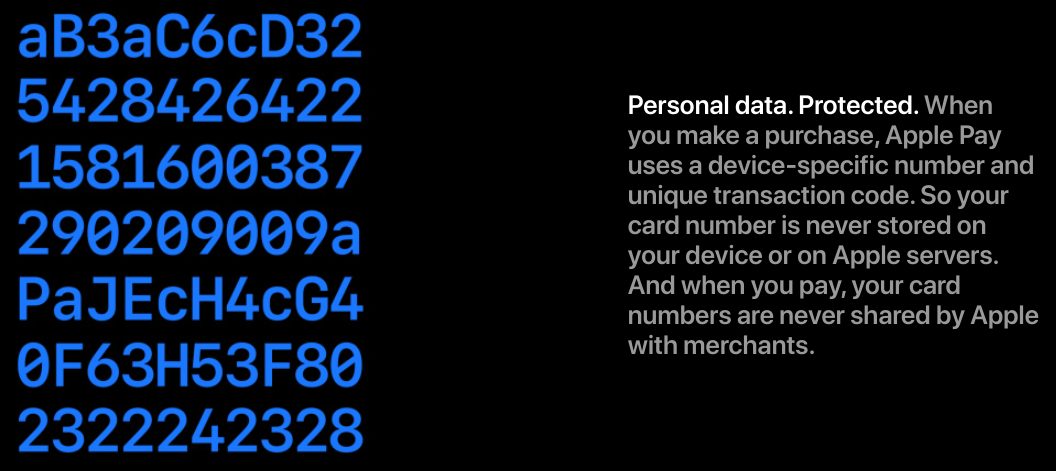
If a user’s phone is accessed by an unauthorized individual, the credit card information remains secure since Apple Pay does not store the actual card data on the device. Instead, it uses tokenization, converting each card’s data into a meaningless sequence that can only be decrypted by Apple and the card networks. This ensures that intercepted tokens cannot be used fraudulently.
Apple has stated that it does not save or share users’ transaction information, a claim that underscores its commitment to user privacy.
Apple Pay’s advanced tokenization enhances payment security.
Employee Reviews & Sales Practices
Straightforward Free Service
Apple markets Apple Pay as a free service for anyone with a compatible iPhone. Apple Pay comes pre-installed on compatible Apple devices, but users will need to add their payment details to the app in order to activate it. The service is free for iPhone users, so it doesn’t even seem possible for Apple to somehow misrepresent its costs in its advertising. This compares favorably in its category to our list of best credit card processors.
The Next Generation of Payment Processing
Like all other products that Apple offers, the company predicates its marketing of this service on its innovative nature. Cut from the cloth of its typical “the future is now” marketing approach, Apple Pay is marketed as a method for payment processing that is already becoming ubiquitous, making traditional merchant accounts all but obsolete. The service is beneficial for merchants who are not charged a fee for debit transactions while credit card payments are charged a flat rate of only 3%. One component of the service is its reliance on NFC technology which allows customers to use their iPhones to process payments. This requires merchants to use payment processing terminals that are NFC compatible, though Apple Pay does not provide that hardware to merchants at this time.
Apple Pay Competitors
Compare Apple Pay to competitors that earned top marks.
Apple Pay may not be the most universally compatible or innovative mobile wallet available, but it holds a unique position as the first mobile wallet to rival actual credit cards in terms of convenience and security. Its seamless integration with Apple’s ecosystem and robust security features, such as biometric authentication and tokenization, provide a level of trust and ease of use that appeals to a wide range of consumers. While Apple Pay may not currently outpace other mobile money transfer apps in terms of flexibility and features, its sleek design and widespread adoption position it favorably within the competitive landscape of mobile payments.
As the market for mobile wallets continues to evolve, Apple Pay’s prominence is likely to grow, especially as more merchants and financial institutions adopt the technology. Its potential for further innovation and increased compatibility makes it a noteworthy player to watch. We will continue to update this review as more information and developments become available, ensuring that our assessment reflects the latest advancements and trends in the mobile payments arena.