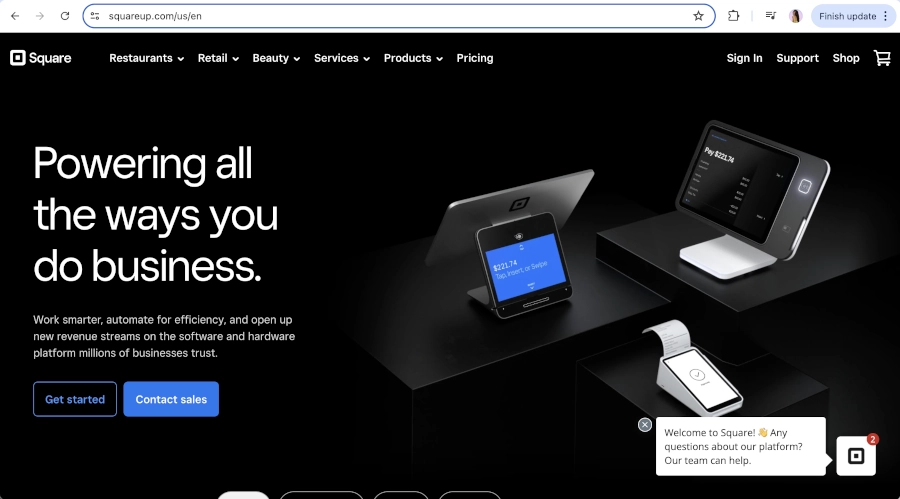
Square’s Processing Fees are Simple
Square is known for its straightforward pricing structure, which is particularly attractive to business owners for its absence of traditional merchant service fees. This includes no activation fees, monthly fees, gateway fees, PCI Compliance fees, downgrade fees, and early termination fees. Outside of transaction fees, Square does not impose additional monthly charges, ensuring no cost is incurred by business owners in periods without sales.
Fees by Transaction Type
Square offers affordable options for processing equipment, such as the magnetic stripe card reader, and recommends the chip card reader for a low cost of $49 to accommodate the shift to chip cards in the U.S. The company maintains a uniform processing fee structure across all merchants utilizing Square Reader or Square Register.
Square’s fees are:
- 2.6% + $0.10 for swiped transactions
- 3.5% + $0.15 for keyed-in transactions
- 2.9% + $0.30 per sale through Square e-commerce
How Square’s Costs Compare
While Square’s swipe rate is higher by approximately 0.80% compared to rates achievable with a traditional merchant account, and the keyed-in rate about 1% higher for similar industries, it offers competitive rates for new businesses. Established businesses aiming for reduced fees might consider our independent statement audit service to uncover and eliminate hidden processing costs.
High Volume Businesses, Heed Caution
Despite not verifying the credit history of prospective customers, Square implements advanced systems to minimize fraud losses. It claims no transaction limits, which has been contested by numerous reviews pointing out that large or frequent sales may prompt funding holds. The specifics of these policies are not transparently communicated in advance.
Square’s Previous Rolling Reserve Policy
Until November 2013, Square enforced holds on funds from card-not-present sales exceeding $2,002 within a seven-day period. This policy was confusing due to the lack of preemptive communication about the limit. Square has since updated its stance, stating there are no processing limits, yet this assertion does not fully align with merchant experiences.
Square’s Current Fraud Triggers
Square now uses undisclosed algorithmic “risk factors” to flag transactions it deems suspicious, which has led to complaints about legitimate transactions being held for extended periods without clear communication. This approach causes uncertainty among merchants regarding transaction security and account stability.
More Transparency Needed For Risky Transactions
Square’s handling of funds from “deactivated” accounts, as opposed to “active” ones, allows it to claim it does not hold merchant funds. However, the lack of clarity and communication around its risk mitigation strategies poses risks for merchants, especially those with higher sales volumes. Improving transparency and communication could significantly enhance Square’s service for these merchants.
Some Minor Improvements Could Raise Square’s Rating
Square offers appealing pricing, contract terms, and processing solutions for many merchants, with no monthly fees or long-term contracts and a straightforward signup process. Nonetheless, the impact of sudden account deactivation on a merchant’s operations limits the company’s rating in this area. Enhancing risk management processes could improve Square’s standing among merchant services.